










Your ancestors’ secrets to stress relief: no alcohol, meditation apps, or pilates required
Modern stress isn’t just “too much to do.” It’s too much input: too late, too fast, too detached from the rhythms the human nervous system was built to trust.
Your ancestors faced real threats: hunger, weather, injury, uncertainty. But their daily life also carried built-in regulators, sun cycles, darkness, movement with purpose, mineral-rich water, nutrient-dense food, and constant contact with the natural world. They didn’t need to “hack” stress because their environment continuously signaled safety, timing, and recovery.
Today, we live in what could be called modern overdrive: artificial light after sunset, blue-lit screens inches from the eyes, irregular meals, stimulant-driven mornings, sedentary days, and nervous systems that rarely get a clear “off switch.” Circadian rhythms get scrambled. Sleep becomes shallow. Cortisol patterns flatten. The body stays vigilant, even when nothing is chasing you.
This article isn’t about romanticizing the past or shaming modern tools like meditation or movement classes. It’s about something more practical: restoring the ancient inputs that tell your biology when to rise, when to recover, and when to let go, with modern science to back it.
The real problem isn't stress, it's rhythm loss
Stress is not inherently harmful. It’s a survival function.
The problem is chronic activation without resolution. When your internal clock can’t reliably predict light, meals, movement, and rest, the body stays on alert; subtly, continuously. Your nervous system becomes less adaptable, not because it’s “weak,” but because it’s missing the signals it evolved to use as anchors.
Circadian rhythms, your body’s 24-hour timing system, coordinate sleep-wake cycles, hormone release, metabolism, mood, and immune signaling.1
When circadian rhythms are disrupted (a common feature of modern life), stress regulation becomes harder and recovery becomes less complete.2
Light is one of the strongest drivers of this system. Specialized pathways connect light exposure to brain regions that regulate circadian timing and arousal.3 In other words: light tells your brain what time it is, and your hormones follow.
When the inputs are wrong, the biology still tries to adapt. But adaptation to chaos has a cost.
The problem isn’t stress. It’s living out of rhythm.
Ancestor secret #1: Sun cycles set the nervous system's "on" and "off"
Your ancestors didn’t “optimize” morning routines. They simply woke up with dawn and lived under a sky that changed predictably every day.
Morning light, especially outdoor daylight, helps set circadian timing and supports healthier sleep-wake patterns.4 Bright light influences alertness and circadian alignment, and consistent light-dark cycles help regulate daily physiological rhythms.3,4
What modern overdrive looks like
- Dim mornings indoors
- Bright evenings under LEDs and screens
- Late-night stimulation that mimics “daytime” to the brain
A more ancestral approach
- Get outdoor light early (even on cloudy days)
- Dim lights after sunset and reduce screen brightness
- Protect darkness like it matters, because it does
Even small shifts, brighter mornings and darker nights, support the biological cadence your nervous system expects.
The body regulates best when it can predict light, darkness, movement, and rest.
Ancestor secret #2: Darkness was real and sleep was deeper
One of the most underestimated stress tools is also the most ancient: uninterrupted darkness.
Modern sleep often happens in a glow: streetlights, hallway LEDs, phone screens, ambient TV light. Yet sleep is one of the primary ways the nervous system recalibrates, supporting emotional processing, stress resilience, and next-day regulation.5
Circadian disruption and shortened sleep are associated with changes in mood, stress responsiveness, and overall resilience.2,5 The goal isn’t perfection, it’s restoring the conditions the brain interprets as “night.”
Restore the signal of night
- Keep the bedroom as dark as possible
- Avoid bright light in the hour before sleep
- Consider warm, low lighting after sunset
- Treat sleep as a biological ritual, not an afterthought
Stress becomes chronic when recovery signals disappear.
Ancestor secret #3: Water wasn't just hydration, it was mineral input
Your ancestors didn’t drink purified, stripped water from plastic. They drank from natural sources, often containing dissolved minerals from rock and soil.
While “mineral-rich spring water” isn’t a magic cure, it points to a real biological truth: minerals matter. Magnesium, in particular, plays key roles in nervous system signaling and stress physiology. 6 Low magnesium status has been associated with greater stress vulnerability, and magnesium is involved in pathways that influence neuromuscular function and neurochemical balance.6
Clinical research suggests magnesium supplementation may support subjective stress and anxiety outcomes in certain populations, though results vary by study design and baseline status.7 This doesn’t mean “take magnesium and you’ll be calm.” It means magnesium is a foundational resource your body uses to regulate.
Modern diets and modern water often deliver fewer minerals than traditional patterns did.6 And modern stress increases demand.
What an ancestral mineral rhythm looks like
- Mineral-rich whole foods (leafy greens, seafood, cacao, nuts)
- Consistent hydration
- Magnesium as a foundational mineral, especially when lifestyle is demanding
This is one reason ancestral cultures prized mineral springs: not as wellness theater, but as replenishment.
Resilience was once built into the day itself.
Ancestor secret #4: Contact with nature quieted the brain without "trying"
Your ancestors didn’t schedule “nature time.” They lived inside it.
Modern research suggests that exposure to natural environments is associated with measurable shifts in stress-related physiology and mood. Studies on nature walks and green space exposure have linked time in nature with reduced rumination and improved emotional state.8 Large-scale reviews also associate green space exposure with improved wellbeing outcomes.9
This matters because chronic stress is often fueled by a mind that never stops scanning, scrolling, comparing, consuming, and planning.
Nature offers a different kind of input: low-threat complexity. It holds attention gently. It regulates through sensory reality: wind, birds, shadows, distance, texture.
Rewilding stress regulation can be simple
- Walk outside without headphones
- Spend time near trees, water, or open sky
- Let your eyes track distance (not just a screen)
You don’t need to “clear your mind.” You just need to give your nervous system a world it recognizes.
You don’t need to silence your mind. You need to give your nervous system a world it recognizes.
Ancestor secret #5: Movement was frequent, varied, and purposeful
Your ancestors didn’t “work out.” They moved because life required it.
Modern movement tends to be compressed: one intense session, followed by hours of sitting. But the nervous system is regulated by regular, low-level motion, like walking, carrying, squatting, stretching, and climbing.
Physical activity is consistently associated with improved stress resilience and mood regulation.10
The most ancestral form is also the most accessible: walking.
Movement doesn’t have to be formal to be effective. In fact, the nervous system often responds best to movement that feels safe, rhythmic, and non-performative.
Your nervous system still expects the world your ancestors lived in.
Ancestor secret #6: They had built-In “downshifts” all day long
Modern life stacks stimulation without pause: notifications, meetings, traffic, caffeine, noise. Your ancestors had long stretches of repetitive, grounding tasks like preparing food, tending fires, walking, gathering, and repairing.
These moments weren’t “mindfulness.” They were nervous system downshifts. They were slow, tangible, sensory-based activities that created recovery throughout the day.
Today, we often try to force recovery at the end of the day, sometimes with alcohol, sometimes with collapse. But ancestral regulation happened in rhythm: effort, recovery, effort, recovery.
That pattern matters.
When the signals are wrong, the biology still adapts, but adaptation to chaos has a cost.
A modern-ancestral protocol: rebuild rhythm in 5 inputs
If modern stress is modern overdrive, the antidote is not more coping tools, it’s restoring the biological signals that prevent overdrive in the first place.
Here’s a practical, ancestral-aligned reset:
1) Morning Light (10–20 minutes outdoors)
Supports circadian timing and daily rhythm cues.3,4
2) Dark Nights (protect the last hour)
Supports sleep depth and nervous system recovery.5
3) Minerals (food-first, magnesium-aware)
Magnesium supports neuromuscular and neurochemical regulation.6,7
4) Nature Contact (small daily doses)
Green space exposure is linked to stress and mood benefits.8,9
5) Frequent Walking (especially daylight walking)
Movement supports mood regulation and resilience10
This isn’t a trend. It’s a return to inputs your body understands.
Frequently Asked Questions
Is modern stress really different from ancestral stress?
Yes. Ancestral stress was often acute and resolved (danger, exertion, scarcity). Modern stress is frequently chronic, low-grade, and paired with circadian disruption, poor sleep, and constant stimulation.8,9
Do I need to give up meditation or Pilates?
No. Those can be valuable tools. The point is that your ancestors didn’t rely on them because their environment delivered regulation automatically. Restoring rhythm makes modern tools work better, and feel less like a lifeline.
What does mineral-rich water have to do with stress?
Natural waters can contain minerals like magnesium and calcium. Magnesium is involved in nervous system function and stress-related pathways, and some research suggests supplementation may support subjective stress measures in certain groups.8,9
How fast can rhythm changes help?
Some people notice shifts in sleep timing and mood within days of brighter mornings and darker nights, while deeper resilience builds over weeks. Consistency matters more than intensity.8,9
The takeaway: your nervous system remembers nature
Your ancestors didn’t need alcohol, meditation apps, or Pilates to relieve stress. Not because they were “better,” but because they lived inside a world that delivered regulation automatically.
Their biology was guided by:
- Sun and darkness
- Minerals and whole foods
- Movement and nature contact
- Predictable rhythms
Modern overdrive isn’t a personal failure. It’s an environmental mismatch. And the most powerful stress strategy is often the simplest: Return to rhythm. Return to what’s innate.
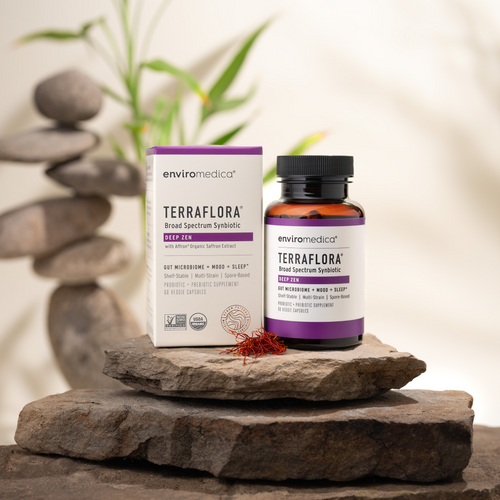
Restoring gut-brain communication is one practical step toward reclaiming a healthy stress response. Enviromedica's Terraflora Deep Zen pairs soil-based probiotics with ingredients that support the gut-brain axis, helping to promote calm focus and emotional balance.
References
- 1. Bass, Joseph, and Mitchell A. Lazar. “Circadian Time Signatures of Fitness and Disease.” Science, vol. 354, no. 6315, 2016, pp. 994–999.
- 2.Wright, Kenneth P., Jr., et al. “Circadian and Wakefulness-Sleep Modulation of Cognition in Humans.” Frontiers in Molecular Neuroscience, vol. 5, 2012, article 50.
- 3.LeGates, Tara A., et al. “Light as a Central Modulator of Circadian Rhythms, Sleep and Affect.” Nature Reviews Neuroscience, vol. 15, no. 7, 2014, pp. 443–454.
- 4.Stothard, Ellen R., et al. “Circadian Entrainment to the Natural Light-Dark Cycle across Seasons and the Weekend.” Current Biology, vol. 27, no. 4, 2017, pp. 508–513.
- 5.Walker, Matthew P. “The Role of Sleep in Cognition and Emotion.” Annals of the New York Academy of Sciences, vol. 1156, 2009, pp. 168–197.
- 6.de Baaij, Jeroen H. F., et al. “Magnesium in Man: Implications for Health and Disease.” Physiological Reviews, vol. 95, no. 1, 2015, pp. 1–46.
- 7.Boyle, Nicola B., et al. “The Effects of Magnesium Supplementation on Subjective Anxiety and Stress—A Systematic Review.” Nutrients, vol. 9, no. 5, 2017, article 429.
- 8.Bratman, Gregory N., et al. “Nature Experience Reduces Rumination and Subgenual Prefrontal Cortex Activation.” Proceedings of the National Academy of Sciences, vol. 112, no. 28, 2015, pp. 8567–8572.
- 9.Twohig-Bennett, Christopher, and Andy Jones. “The Health Benefits of the Great Outdoors: A Systematic Review and Meta-Analysis of Greenspace Exposure and Health Outcomes.” Environmental Research, vol. 166, 2018, pp. 628–637.
- 10.Rebar, Amanda L., et al. “A Meta-Analysis of the Effect of Physical Activity on Depression and Anxiety in Non-Clinical Adult Populations.” Health Psychology Review, vol. 9, no. 3, 2015, pp. 366–378.
MOOD + SLEEP SUPPORT

DAILY GUT HEALTH


Your ancestors’ secrets to stress relief: no alcohol, meditation apps, or pilates required
Modern stress isn’t just “too much to do.” It’s too much input: too late, too fast, too detached from the rhythms the human nervous system was built to trust.
Your ancestors faced real threats: hunger, weather, injury, uncertainty. But their daily life also carried built-in regulators, sun cycles, darkness, movement with purpose, mineral-rich water, nutrient-dense food, and constant contact with the natural world. They didn’t need to “hack” stress because their environment continuously signaled safety, timing, and recovery.
Today, we live in what could be called modern overdrive: artificial light after sunset, blue-lit screens inches from the eyes, irregular meals, stimulant-driven mornings, sedentary days, and nervous systems that rarely get a clear “off switch.” Circadian rhythms get scrambled. Sleep becomes shallow. Cortisol patterns flatten. The body stays vigilant, even when nothing is chasing you.
This article isn’t about romanticizing the past or shaming modern tools like meditation or movement classes. It’s about something more practical: restoring the ancient inputs that tell your biology when to rise, when to recover, and when to let go, with modern science to back it.
The real problem isn't stress, it's rhythm loss
Stress is not inherently harmful. It’s a survival function.
The problem is chronic activation without resolution. When your internal clock can’t reliably predict light, meals, movement, and rest, the body stays on alert; subtly, continuously. Your nervous system becomes less adaptable, not because it’s “weak,” but because it’s missing the signals it evolved to use as anchors.
Circadian rhythms, your body’s 24-hour timing system, coordinate sleep-wake cycles, hormone release, metabolism, mood, and immune signaling.1
When circadian rhythms are disrupted (a common feature of modern life), stress regulation becomes harder and recovery becomes less complete.2
Light is one of the strongest drivers of this system. Specialized pathways connect light exposure to brain regions that regulate circadian timing and arousal.3 In other words: light tells your brain what time it is, and your hormones follow.
When the inputs are wrong, the biology still tries to adapt. But adaptation to chaos has a cost.
The problem isn’t stress. It’s living out of rhythm.
Ancestor secret #1: Sun cycles set the nervous system's "on" and "off"
Your ancestors didn’t “optimize” morning routines. They simply woke up with dawn and lived under a sky that changed predictably every day.
Morning light, especially outdoor daylight, helps set circadian timing and supports healthier sleep-wake patterns.4 Bright light influences alertness and circadian alignment, and consistent light-dark cycles help regulate daily physiological rhythms.3,4
What modern overdrive looks like
- Dim mornings indoors
- Bright evenings under LEDs and screens
- Late-night stimulation that mimics “daytime” to the brain
A more ancestral approach
- Get outdoor light early (even on cloudy days)
- Dim lights after sunset and reduce screen brightness
- Protect darkness like it matters, because it does
Even small shifts, brighter mornings and darker nights, support the biological cadence your nervous system expects.
The body regulates best when it can predict light, darkness, movement, and rest.
Ancestor secret #2: Darkness was real and sleep was deeper
One of the most underestimated stress tools is also the most ancient: uninterrupted darkness.
Modern sleep often happens in a glow: streetlights, hallway LEDs, phone screens, ambient TV light. Yet sleep is one of the primary ways the nervous system recalibrates, supporting emotional processing, stress resilience, and next-day regulation.5
Circadian disruption and shortened sleep are associated with changes in mood, stress responsiveness, and overall resilience.2,5 The goal isn’t perfection, it’s restoring the conditions the brain interprets as “night.”
Restore the signal of night
- Keep the bedroom as dark as possible
- Avoid bright light in the hour before sleep
- Consider warm, low lighting after sunset
- Treat sleep as a biological ritual, not an afterthought
Stress becomes chronic when recovery signals disappear.
Ancestor secret #3: Water wasn't just hydration, it was mineral input
Your ancestors didn’t drink purified, stripped water from plastic. They drank from natural sources, often containing dissolved minerals from rock and soil.
While “mineral-rich spring water” isn’t a magic cure, it points to a real biological truth: minerals matter. Magnesium, in particular, plays key roles in nervous system signaling and stress physiology. 6 Low magnesium status has been associated with greater stress vulnerability, and magnesium is involved in pathways that influence neuromuscular function and neurochemical balance.6
Clinical research suggests magnesium supplementation may support subjective stress and anxiety outcomes in certain populations, though results vary by study design and baseline status.7 This doesn’t mean “take magnesium and you’ll be calm.” It means magnesium is a foundational resource your body uses to regulate.
Modern diets and modern water often deliver fewer minerals than traditional patterns did.6 And modern stress increases demand.
What an ancestral mineral rhythm looks like
- Mineral-rich whole foods (leafy greens, seafood, cacao, nuts)
- Consistent hydration
- Magnesium as a foundational mineral, especially when lifestyle is demanding
This is one reason ancestral cultures prized mineral springs: not as wellness theater, but as replenishment.
Resilience was once built into the day itself.
Ancestor secret #4: Contact with nature quieted the brain without "trying"
Your ancestors didn’t schedule “nature time.” They lived inside it.
Modern research suggests that exposure to natural environments is associated with measurable shifts in stress-related physiology and mood. Studies on nature walks and green space exposure have linked time in nature with reduced rumination and improved emotional state.8 Large-scale reviews also associate green space exposure with improved wellbeing outcomes.9
This matters because chronic stress is often fueled by a mind that never stops scanning, scrolling, comparing, consuming, and planning.
Nature offers a different kind of input: low-threat complexity. It holds attention gently. It regulates through sensory reality: wind, birds, shadows, distance, texture.
Rewilding stress regulation can be simple
- Walk outside without headphones
- Spend time near trees, water, or open sky
- Let your eyes track distance (not just a screen)
You don’t need to “clear your mind.” You just need to give your nervous system a world it recognizes.
You don’t need to silence your mind. You need to give your nervous system a world it recognizes.
Ancestor secret #5: Movement was frequent, varied, and purposeful
Your ancestors didn’t “work out.” They moved because life required it.
Modern movement tends to be compressed: one intense session, followed by hours of sitting. But the nervous system is regulated by regular, low-level motion, like walking, carrying, squatting, stretching, and climbing.
Physical activity is consistently associated with improved stress resilience and mood regulation.10
The most ancestral form is also the most accessible: walking.
Movement doesn’t have to be formal to be effective. In fact, the nervous system often responds best to movement that feels safe, rhythmic, and non-performative.
Your nervous system still expects the world your ancestors lived in.
Ancestor secret #6: They had built-In “downshifts” all day long
Modern life stacks stimulation without pause: notifications, meetings, traffic, caffeine, noise. Your ancestors had long stretches of repetitive, grounding tasks like preparing food, tending fires, walking, gathering, and repairing.
These moments weren’t “mindfulness.” They were nervous system downshifts. They were slow, tangible, sensory-based activities that created recovery throughout the day.
Today, we often try to force recovery at the end of the day, sometimes with alcohol, sometimes with collapse. But ancestral regulation happened in rhythm: effort, recovery, effort, recovery.
That pattern matters.
When the signals are wrong, the biology still adapts, but adaptation to chaos has a cost.
A modern-ancestral protocol: rebuild rhythm in 5 inputs
If modern stress is modern overdrive, the antidote is not more coping tools, it’s restoring the biological signals that prevent overdrive in the first place.
Here’s a practical, ancestral-aligned reset:
1) Morning Light (10–20 minutes outdoors)
Supports circadian timing and daily rhythm cues.3,4
2) Dark Nights (protect the last hour)
Supports sleep depth and nervous system recovery.5
3) Minerals (food-first, magnesium-aware)
Magnesium supports neuromuscular and neurochemical regulation.6,7
4) Nature Contact (small daily doses)
Green space exposure is linked to stress and mood benefits.8,9
5) Frequent Walking (especially daylight walking)
Movement supports mood regulation and resilience10
This isn’t a trend. It’s a return to inputs your body understands.
Frequently Asked Questions
Is modern stress really different from ancestral stress?
Yes. Ancestral stress was often acute and resolved (danger, exertion, scarcity). Modern stress is frequently chronic, low-grade, and paired with circadian disruption, poor sleep, and constant stimulation.8,9
Do I need to give up meditation or Pilates?
No. Those can be valuable tools. The point is that your ancestors didn’t rely on them because their environment delivered regulation automatically. Restoring rhythm makes modern tools work better, and feel less like a lifeline.
What does mineral-rich water have to do with stress?
Natural waters can contain minerals like magnesium and calcium. Magnesium is involved in nervous system function and stress-related pathways, and some research suggests supplementation may support subjective stress measures in certain groups.8,9
How fast can rhythm changes help?
Some people notice shifts in sleep timing and mood within days of brighter mornings and darker nights, while deeper resilience builds over weeks. Consistency matters more than intensity.8,9
The takeaway: your nervous system remembers nature
Your ancestors didn’t need alcohol, meditation apps, or Pilates to relieve stress. Not because they were “better,” but because they lived inside a world that delivered regulation automatically.
Their biology was guided by:
- Sun and darkness
- Minerals and whole foods
- Movement and nature contact
- Predictable rhythms
Modern overdrive isn’t a personal failure. It’s an environmental mismatch. And the most powerful stress strategy is often the simplest: Return to rhythm. Return to what’s innate.
Restoring gut-brain communication is one practical step toward reclaiming a healthy stress response. Enviromedica's Terraflora Deep Zen pairs soil-based probiotics with ingredients that support the gut-brain axis, helping to promote calm focus and emotional balance.
References
- 1. Bass, Joseph, and Mitchell A. Lazar. “Circadian Time Signatures of Fitness and Disease.” Science, vol. 354, no. 6315, 2016, pp. 994–999.
- 2.Wright, Kenneth P., Jr., et al. “Circadian and Wakefulness-Sleep Modulation of Cognition in Humans.” Frontiers in Molecular Neuroscience, vol. 5, 2012, article 50.
- 3.LeGates, Tara A., et al. “Light as a Central Modulator of Circadian Rhythms, Sleep and Affect.” Nature Reviews Neuroscience, vol. 15, no. 7, 2014, pp. 443–454.
- 4.Stothard, Ellen R., et al. “Circadian Entrainment to the Natural Light-Dark Cycle across Seasons and the Weekend.” Current Biology, vol. 27, no. 4, 2017, pp. 508–513.
- 5.Walker, Matthew P. “The Role of Sleep in Cognition and Emotion.” Annals of the New York Academy of Sciences, vol. 1156, 2009, pp. 168–197.
- 6.de Baaij, Jeroen H. F., et al. “Magnesium in Man: Implications for Health and Disease.” Physiological Reviews, vol. 95, no. 1, 2015, pp. 1–46.
- 7.Boyle, Nicola B., et al. “The Effects of Magnesium Supplementation on Subjective Anxiety and Stress—A Systematic Review.” Nutrients, vol. 9, no. 5, 2017, article 429.
- 8.Bratman, Gregory N., et al. “Nature Experience Reduces Rumination and Subgenual Prefrontal Cortex Activation.” Proceedings of the National Academy of Sciences, vol. 112, no. 28, 2015, pp. 8567–8572.
- 9.Twohig-Bennett, Christopher, and Andy Jones. “The Health Benefits of the Great Outdoors: A Systematic Review and Meta-Analysis of Greenspace Exposure and Health Outcomes.” Environmental Research, vol. 166, 2018, pp. 628–637.
- 10.Rebar, Amanda L., et al. “A Meta-Analysis of the Effect of Physical Activity on Depression and Anxiety in Non-Clinical Adult Populations.” Health Psychology Review, vol. 9, no. 3, 2015, pp. 366–378.


